
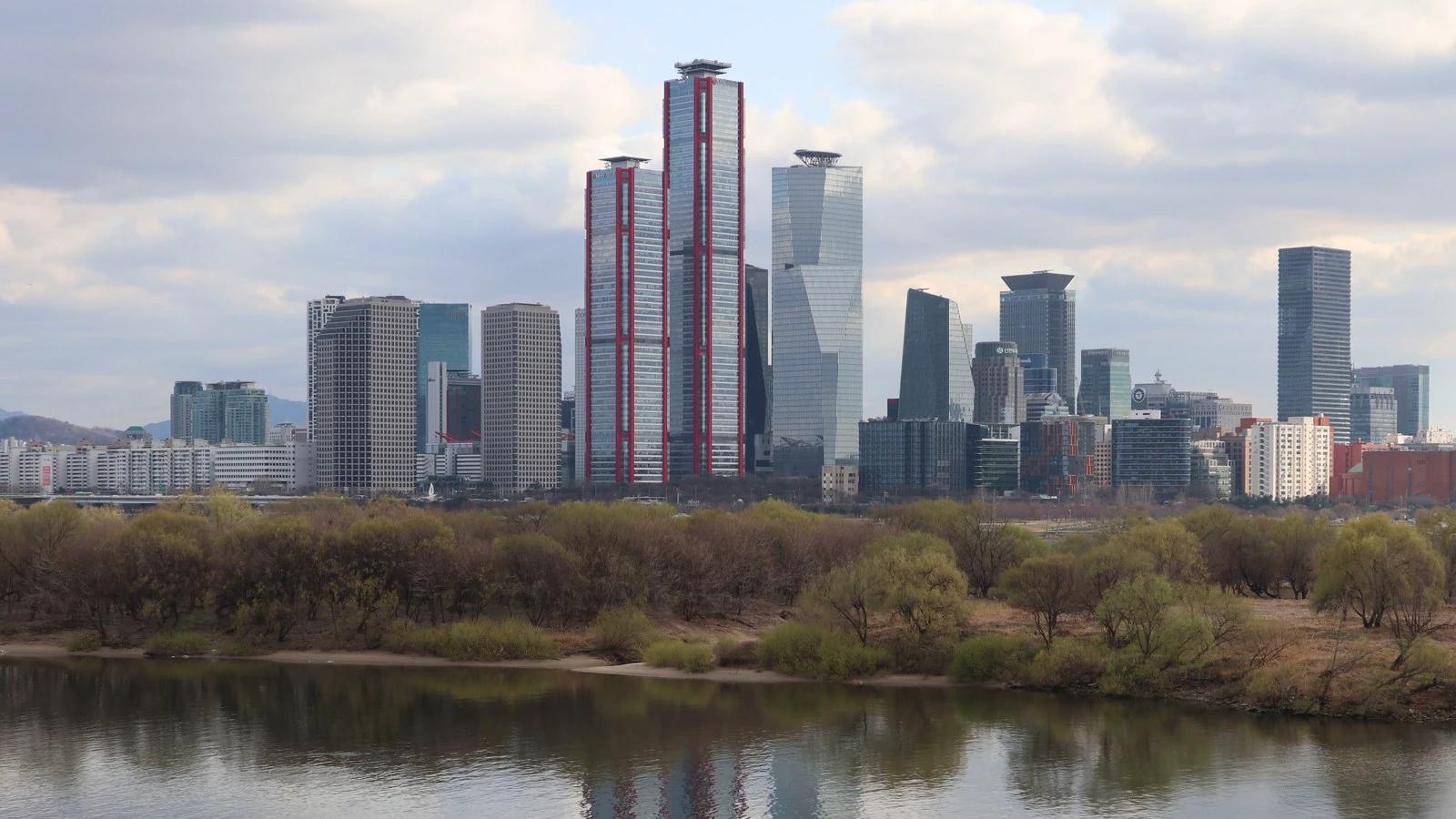
In the Korea Real Estate Board's (한국부동산원) weekly apartment price survey for the week of 23 November 2026, released on 26 November, sale prices in Seoul rose 0.01%, down from 0.03% a week earlier. The board reports Seoul in two groups of districts, as it did in the week covered by Seoul apartment prices slow to 0.03% as the board's Gangnam group falls 0.08% and its Gangbuk group rises 0.15%. It labels them Gangbuk (강북), with 14 districts, and Gangnam (강남), with 11. The Gangbuk group rose 0.15%, the same as a week earlier. The Gangnam group fell 0.11%, a deeper decline than the 0.08% fall of the previous week. The Gangnam group is wider than Gangnam-gu, which is one of its 11 districts.
The board says prices rose mainly in large complexes with good living conditions and near metro stations, while contracts at lower prices were signed in some areas, with rises and falls mixed by district, so Seoul as a whole still rose.
Among the Gangnam group, the board records the largest falls in Songpa-gu, down 0.50%, mainly in major complexes in Jamsil and Munjeong; Gangnam-gu, down 0.34%, mainly in large complexes in Daechi and Apgujeong; and Seocho-gu, down 0.30%, mainly in Banpo and Jamwon. A week earlier the same three districts had fallen 0.42%, 0.30% and 0.31%. The board names Geumcheon-gu, up 0.16% mainly in Siheung and Doksan, and Gangseo-gu, up 0.15% mainly in small and mid-size units in Banghwa and Hwagok, as the group's risers.
Among the Gangbuk group, the board says Yongsan-gu fell 0.03%, mainly in Ichon and Hannam, and Seongdong-gu fell 0.01%, mainly in major complexes in Haengdang and Eungbong. Yongsan-gu had fallen 0.02% the week before. The largest rises were in Seongbuk-gu, up 0.33% mainly in large complexes in Jeongneung and Donam; Nowon-gu, up 0.27% mainly near metro stations in Sanggye and Junggye; and Seodaemun-gu, up 0.25% mainly in small and mid-size units in Hongje and Hongeun. Counting the board's district table, nine of Seoul's 25 districts fell this week, up from seven a week earlier. Gwangjin-gu, Yeongdeungpo-gu and Dongjak-gu each fell 0.01%, and Gangdong-gu fell 0.03%. The release text gives no neighbourhood breakdown for those four.
Across the country, the sale-price index rose 0.05%, down from 0.06%. The capital region rose 0.10%, down from 0.12%, with Gyeonggi up 0.17%, down from 0.21%, and Incheon up 0.02%, after a flat 0.00% reading a week earlier. Areas outside the capital region were flat at 0.00%, as they were a week earlier. The board says 101 of the 182 districts and cities it publishes rose, 9 were flat and 72 fell, against 104, 10 and 68 a week earlier.
Jeonse, the large refundable deposit that stands in for monthly rent in many Seoul apartments, rose 0.14% in Seoul, the same as a week earlier. The capital region's rose 0.14% and the country's 0.09%, up from 0.08%. The board says rising contracts were signed mainly near metro stations with tenant demand and in large complexes, while some complexes saw downward-adjusted trades, so Seoul as a whole still rose. Its Gangbuk group rose 0.19% and its Gangnam group 0.09%, against 0.16% and 0.11% in the 16 November release. In Gangnam-gu, jeonse rose 0.14%, mainly in Gaepo and Suseo, in a week when that district's sale prices fell 0.34%. The October monthly averages for Seoul jeonse deposits, from a different series published by KB Kookmin Bank, are covered in Seoul apartment jeonse average hits ₩729 million in KB's October 2026 reading. A separate guide, Buying and holding a Seoul home as a foreigner, sets out the rules an overseas buyer meets in the city.
These figures are weekly changes in the board's apartment price indices, drawn from a survey, not a count of every signed contract.
Sources
Sources read 26 November 2026.
- 주간아파트가격동향(20261123기준), Korea Real Estate Board (한국부동산원) press-release page, registered 26 November 2026, read 26 November 2026.
- 전국주택가격동향조사 : 2026년 11월 4주 주간 아파트가격 동향, Korea Real Estate Board weekly apartment price trends, survey week of 23 November 2026, released 26 November 2026, PDF attached to the press-release page as
!261126(보도자료)_주간아파트가격동향(20261123기준).pdf, read 26 November 2026. - 주간아파트가격동향(20261116기준), Korea Real Estate Board (한국부동산원) press-release page, registered 19 November 2026, read 26 November 2026, used for the previous week's group figures.
- 전국주택가격동향조사 : 2026년 11월 3주 주간 아파트가격 동향, Korea Real Estate Board weekly apartment price trends, survey week of 16 November 2026, released 19 November 2026, PDF attached to the press-release page as
!261119(보도자료)_주간아파트가격동향(20261116기준).pdf, read 26 November 2026.